While walking the Camino de Santiago is a feat in and of itself, more and more pilgrims are choosing not to end their adventure in front of the cathedral. Rather, they’re lacing up their shoes, putting their packs back on, and continuing onwards to the Atlantic Ocean and the “end of the world” on the Camino Finisterre.
Finisterre, which literally means end of the earth, has an undeniably special energy. (There’s a reason some pilgrims never leave). In the past, this small Galician village was believed to be the most western point in the world (before we knew better), attracting pagans and magical folk to its shores. Sun worship was common, and to this day crowds of people gather on the rocks at Cape Finisterre to watch the beautiful sunsets. It’s also been nicknamed the Costa da Morte (Coast of Death) due to its stormy nature and the many shipwrecks that decorate the coastline. In short, it’s a fitting place to breathe in fresh ocean air and end your Camino.
The Camino Finisterre is a shorter Camino, typically taking around three to five days to complete. I chose to continue on from Santiago after walking the Portuguese Camino, but you can walk to Finisterre as its own Camino or as part of another one, depending on how much time you have.
If you’ve been thinking about walking the Camino Finisterre, this guide will fill you in on all you need to know, including recommended daily walking stages and the best places to sleep and eat. Let’s jump in!
Camino Finisterre Walking Stages
As mentioned, the length of the Camino Finisterre can vary, depending on how much time and energy you have. While the following three-day route is a bit ambitious (I was super exhausted on the last day walking into Finisterre), there are some optional stops you can add to break up the longer second and third day if you have time. More on this below!
Day One: Santiago to Negreira
The first leg of the Camino Finisterre starts at the cathedral in Santiago and continues on for 21 km to Negreira, a town with several restaurants, grocery stores, pharmacies, ATMs, and places to sleep. It’s the last place to stock up on groceries and other supplies before Cee, about a 50 km distance away. The municipal albergue is about 1 km past the town, so grab some groceries before heading there for the night.
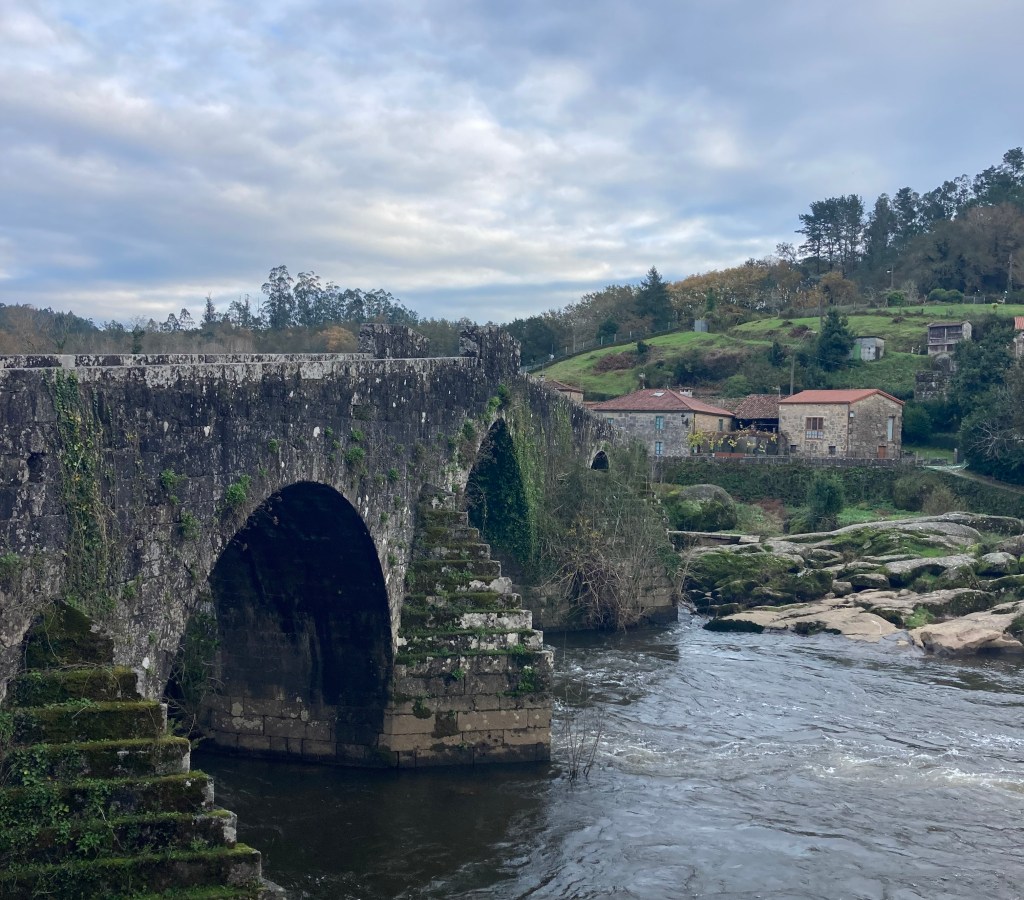
The walk itself is pretty manageable. There are some slight up and down hills for much of the way and you’ll go past some nice sights, including a medieval bridge over Rio Roxos, a Baroque church in Trasmonte, and Ponte Maceira, a cute town where you can stop for lunch or a coffee break.
If you’d like to break this stage into two parts, you can spend the night in Roxos, which is about 8 km from Santiago.
Day Two: Negreira to Olveiroa

Get ready, because this second day is a little bit challenging. The 33 km leg starts with a nice walk along a forested path and then takes you through small villages and open fields. While you’ll find several different places to stop for food and coffee, there aren’t any stores on this leg of the route. I stopped for a delicious breakfast at Albergue A Pena, about 8 km from Negreira, and can really recommend taking a break here before continuing on.
Another note is that the latter part of the day seemed to stretch on forever, with a lot of monotonous road walking. If you have extra time and want to set a more leisurely pace, you can spend the night in one of the villages along the way. Check out Gronze for a list of albergues and opening times. When I walked the route in November, few albergues between Negreira and Olveiroa were open.
Day Three: Olveiroa to Finisterre
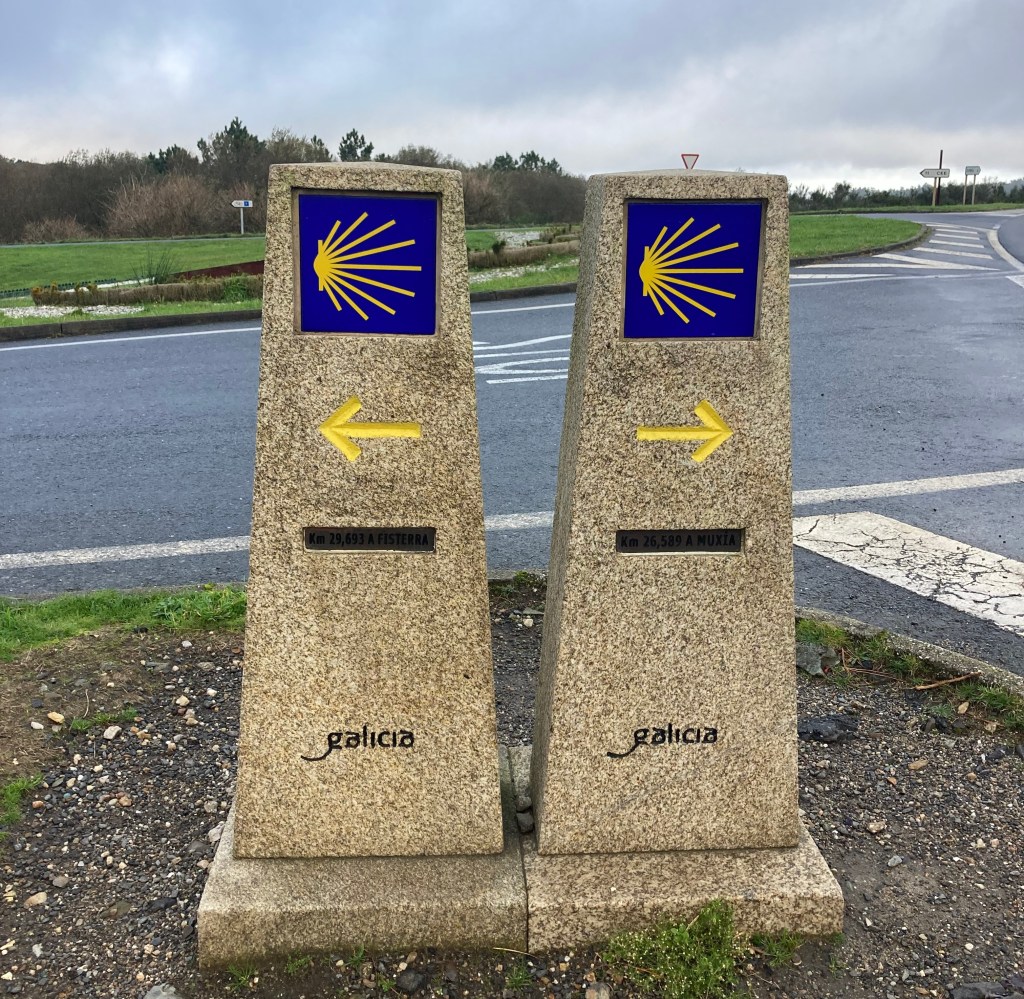
On day three, you have the option to go all the way to Finisterre, or break up the stage into two parts and stop in Cee or Corcubión. Note that in Hospital, the route splits and you have the option to walk to Finisterre or Muxia (it’s indicated by two trail markers). Follow the left arrow to Finisterre.
Despite the length, this day was my favorite part of the Camino Finisterre, from the picturesque town of Cee to the coastal walk leading into Finisterre. The people I walked with were stopping in Corcubión, where there’s a nice donativo that serves dinner. I would have liked to stop with them, but I had a flight to catch from Santiago the following evening, so it was necessary to continue on to Finisterre. Even though it was November, it was warm enough to throw off my backpack and jump into the ocean. The water felt great after a long day and it was refreshing to swim at the earth’s end after walking the Camino Portuguese. All in all, good for the soul.

The lovely walk ends at Cape Finisterre, a rocky headland with a lighthouse, cafe, souvenir shop, and beautiful natural scenery. It’s also home to the iconic kilometer 0 marker. In the past, many pilgrims celebrated the end of their adventure by burning shoes or other possessions and then scattering the ashes into the sea. While this particular tradition is now no longer allowed for health and fire safety reasons, you can still mark the end of your journey by jumping into the ocean or burning a piece of paper with the things you want to let go of, for example. I attempted to burn my piece of paper at the cape, but it was hilariously windy. After fumbling with a lighter for 10 minutes, I gave up on setting anything on fire and pocketed the paper. Hopefully this doesn’t lead to some type of Camino curse.
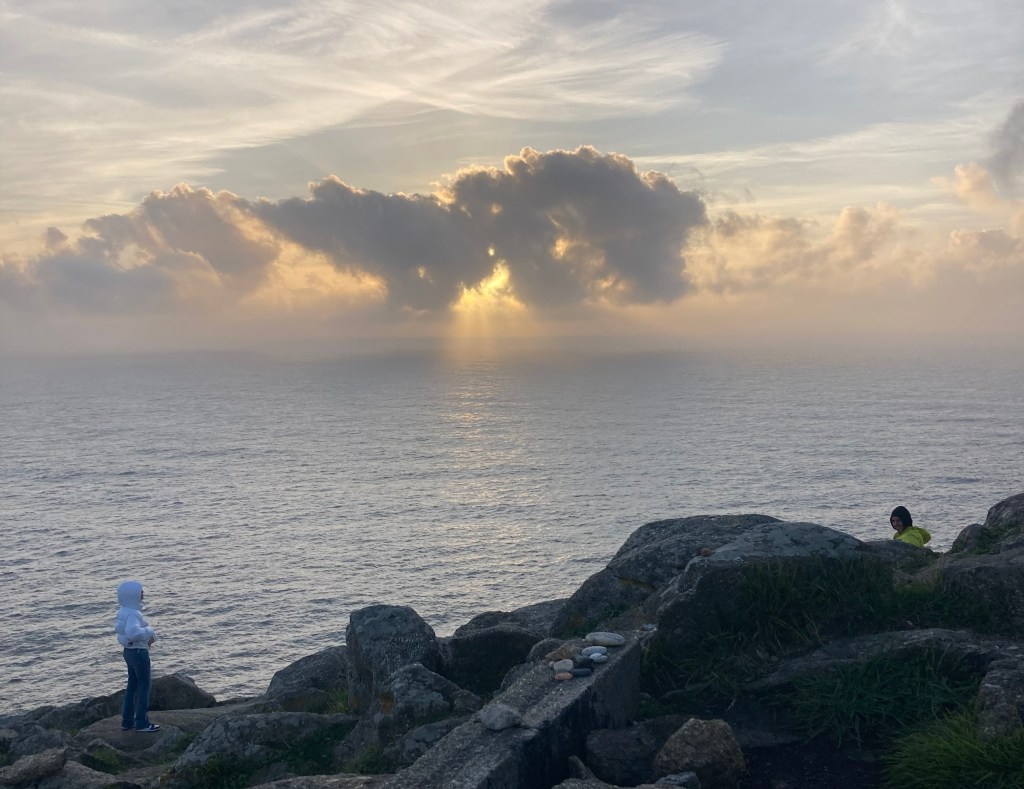
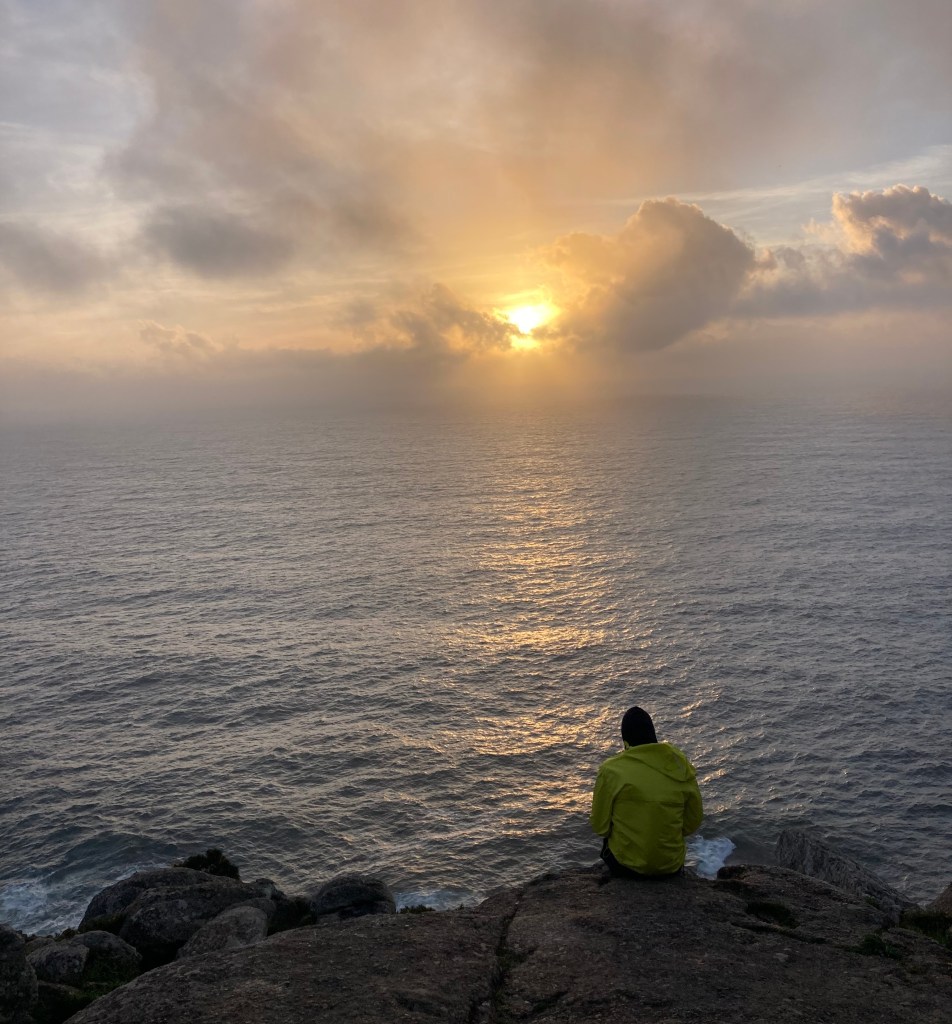
While storm clouds and rain are common at Cape Finisterre, especially in November, I was lucky to have a clear sky for sunset. I settled in on the rocks and watched the sun fade into the horizon line, soaking in the beautiful ocean views and energy of the special place.
There are many albergues and hotels in Finisterre to choose from, although I recommend staying at Albergue de Sonia. Note that the municipal albergue doesn’t have the best reviews. At Sonia’s, I found a nice kitchen and communal area with comfy couches for hanging out. There was also a nice crowd of pilgrims, all finding themselves at a crossroads and figuring out where they wanted life to take them next. Some had been staying at Sonia’s for days, weeks, and, in the case of one French guy, months. There were some fun discussions and musings that evening.
In terms of cafes, Batidor Pasteria is a must-visit. Located next to the bus station walking into town, you’ll find delicious pastries, coffee, matcha lattes, and probably some pilgrims discussing the Camino at this place.
You can pick up the Fisterrana, the equivalent to the Compostela certificate, at the tourist office or the municipal albergue if you’re there during the winter months.
Continuing on the Camino Muxía

A wise pilgrim once told me that it’s important to continue on to Muxía after walking to Finisterre. As she said, “Go to Finisterre to die, and then go to Muxía to be reborn.”
Muxía is a small fishing village on the Galician coast, about 28 km from Finisterre. According to legend, Muxía is the landing place for the Virgin Mary and the stone boat that carried her to Galicia to meet St. James, who she helped and encouraged to preach throughout Galicia.
Today, you can visit the remains of her stone boat, including the boat frame (Pedra de Abalar), the sail (Pedra dos Cadrís), and the rudder (Pedra do Timón). These stones are said to be healing with magical properties. It’s also said that if you crawl under and around the boat frame nine times, you’ll be reborn. I did this, and it was actually way more physically exhausting than I thought. Phew!

To mark the Virgin Mary’s arrival, a small church, called Santuario da Virxe da Barca, was constructed on the shore. This architectural gem blends in nicely with the surrounding natural environment.
Although I wasn’t able to walk the leg to Muxía from Finisterre due to time constraints, I’ve heard it’s beautiful and well worth the journey. You can even walk all the way back to Santiago from Muxía if you have time to spare. In my case, I took the short bus ride to Muxía and then explored the church and village for an afternoon before heading back to Santiago.
I’m not sure if I was successfully reborn yet, but I’ll keep you posted.
Buy me a coffee ☕
Choose an amount:
Thanks, your support is appreciated!
Support the blog
 Home Far Away From Home
Leave a comment